
Every kid has had a “Can we get a puppy?” phase, and for some parents, that plea gets even harder to dodge when it lands on a wishlist for Santa. A pet can be a source of companionship, confidence, and plenty of memorable family moments, but parents know that bringing one home is a decision that lasts well beyond the holiday season.
To find out what it takes for a family to feel ready, we surveyed more than 2,000 U.S. parents about the age they believe children are ready to help care for a dog, both nationally and in each state. We also looked at where parents are most open to giving a child a pet as a Christmas or winter-holiday gift, as well as the factors families consider before bringing one home. Finally, we explored how often kids ask for a pet and how quickly parents think the daily responsibilities may land back on the adults.
Key Findings
- According to survey responses, Americans were not personally responsible for a dog until age 17, on average, but parents believe kids are ready to start helping care for one by age 10.
- 64% of parents would not get their kid a dog until they are old enough to walk it.
- 82% of parents believe that growing up with a pet is important for a child’s development.
- More than half of parents (54%) say they would consider giving their kid a pet as a Christmas or holiday gift.
- 66% of kids have asked their parents for a pet for Christmas.
- On average, parents say their children have asked for a pet as a holiday gift nearly six times.
- Nearly 60% of parents believe that if their household got a pet for their kid, the daily responsibility would shift to an adult within four weeks.
When Do Parents Think Kids Are Ready for a Dog?
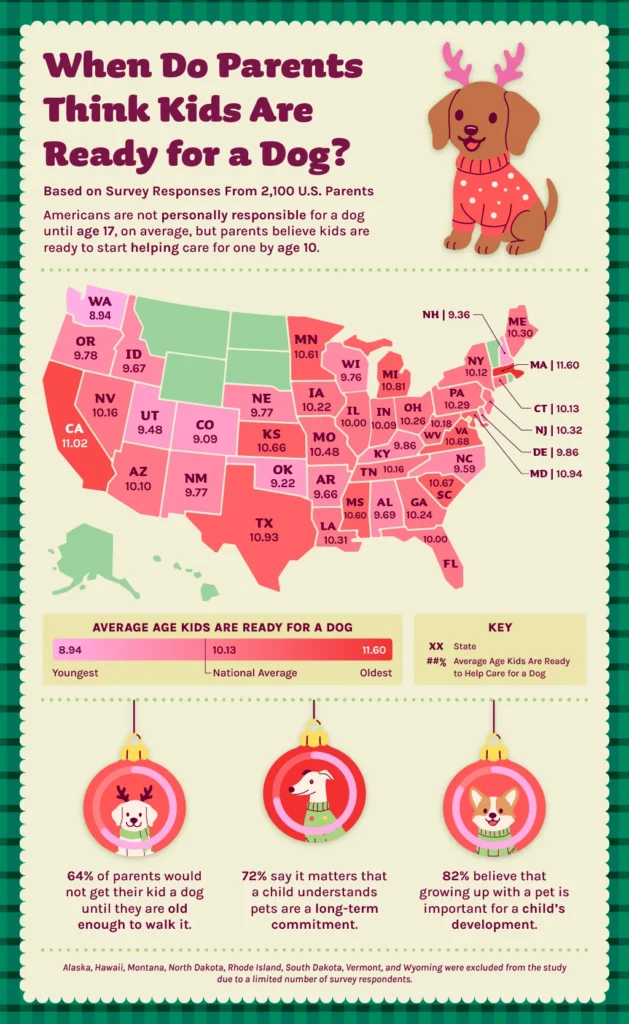
Taking care of a dog all on your own tends to come much later. On average, Americans say they were 17 when they first became personally responsible for a dog. But when it comes to sharing the workload, parents think children are ready to start helping care for a dog at about age 10. That could mean feeding the dog, taking them on walks, and building the daily routines that come with caring for a pet.
The states where parents say kids are ready to take care of a dog at the youngest ages are:
- Washington — 8.94 years old
- Colorado — 9.09
- Oklahoma — 9.22
- New Hampshire — 9.36
- Utah — 9.48
- North Carolina — 9.59
The states where parents are most likely to wait until children are older are:
- Massachusetts — 11.60 years old
- California — 11.02
- Maryland — 10.94
- Texas — 10.93
- Michigan — 10.81
- Virginia — 10.68
Washington has the youngest perceived ready age, with residents saying kids can take care of a dog by 8 years and 11 months, on average. Colorado, Oklahoma, and New Hampshire follow Washington, with parents in each state saying kids are ready to help care for a dog before 9 and a half years old.
Massachusetts parents are most likely to wait longest, putting the average age at 11 years and 7 months. California, Maryland, and Texas are not far behind: parents in those states say children are ready at roughly 11 years old, or just shy of it. Families in these states may be more likely to hold off until kids are closer to middle school before handing over the leash or food scoop.
What Parents Consider Before Bringing Home a Pet
For most families, getting a pet is about much more than responding to a child’s enthusiastic “Can we get a dog?” Eighty-two percent of parents believe growing up with a pet is important for a child’s development, but they are also thinking carefully about what will help the experience go well for everyone involved. In fact, 64% of parents say they would not get their child a dog until the child was old enough to walk it.
The factors parents say matter most when deciding whether a child is ready for a pet are:
- The child’s maturity — 85.9%
- Whether the child behaves safely and gently around animals — 80.2%
- Whether the child understands that pets are a long-term commitment — 71.6%
- The type of pet being considered — 66.8%
- Whether the parents are prepared to assume responsibility — 65.7%
- The household’s financial situation — 60.8%
- The child’s age — 55.0%
- Whether the child consistently completes household chores — 48.1%
Parents are far more focused on a child’s maturity than a specific age. While 86% say maturity is an important factor in deciding whether a child is ready for a pet, just 55% point to age. That suggests there is no universal “right” age. It’s more about whether a child is ready to treat an animal with care and understand the day-to-day commitment involved.
Seventy-two percent of parents say it matters that a child understands a pet is a long-term commitment. And about two-thirds factor in the type of pet and whether the adults in the household are prepared to share responsibility. In other words, pet readiness is really family readiness.
Families Are Thinking Through the Whole Picture
Before bringing home a pet, parents are also considering the practical pieces that make pet ownership feel manageable.
The biggest factors that could prevent a household from getting a pet are:
- Veterinary expenses — 67.1%
- The cost of food and supplies — 51.1%
- My work schedule or lack of time — 44.0%
- Existing pets — 40.8%
- Travel plans or difficulty finding pet care — 36.0%
- My child is not responsible enough — 35.2%
- My child is too young — 32.2%
- Housing or landlord restrictions — 30.8%
- Not enough space — 30.7%
- Allergies — 29.7%
- Concern about damage, messes, or cleaning — 27.9%
Veterinary expenses are the biggest consideration, followed by the cost of food and supplies. Work schedule, finding pet care while traveling, and the needs of any existing pets at home are also big barriers.
Where Are Kids Most Likely to Get A Pet for Christmas?
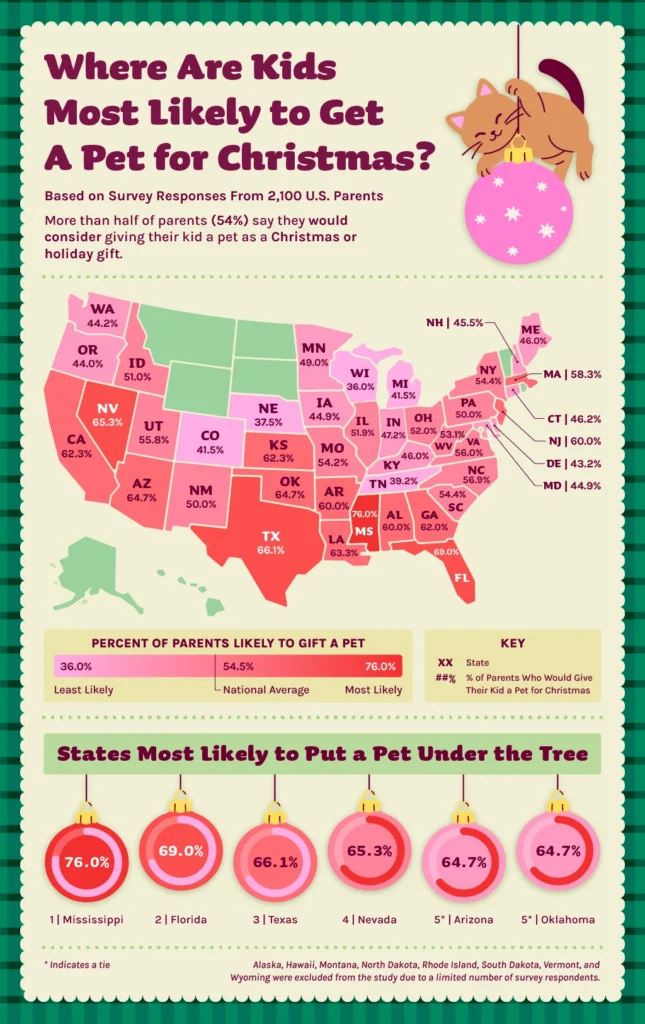
For some families, a pet can feel like the ultimate holiday surprise. More than half of parents nationwide (54.5%) say they would consider giving their child a pet as a Christmas or winter-holiday present. Of course, the decision comes with plenty to think through, from the child’s readiness to the family’s routine and the needs of the animal. Still, parents in a handful of states are especially open to making a new pet part of the celebration.
The states where parents are most likely to consider giving their child a pet as a holiday gift are:
- Mississippi — 76.0%
- Florida — 69.0%
- Texas — 66.1%
- Nevada — 65.3%
- Arizona — 64.7%
- Oklahoma — 64.7%
Mississippi leads the country, with more than three in four parents (76%) saying they would consider a pet as a holiday gift, 21.5 percentage points above the national average. Florida and Texas follow, with 69% of Florida parents and nearly two-thirds of Texas parents (66.1%) open to the idea. Six of the 10 states most likely to consider a holiday pet gift are in the South: Mississippi, Florida, Texas, Oklahoma, Louisiana, and Georgia.
The idea may be popular, but it is not purely hypothetical. One in five parents nationally (20%) say they have actually given a child a pet as a Christmas or winter-holiday gift. Among parents who celebrate Christmas and have given a child a pet as a Christmas gift, 31% say they felt pressured to do so because their child asked Santa for one.
How Often Kids Ask for a Pet for Christmas
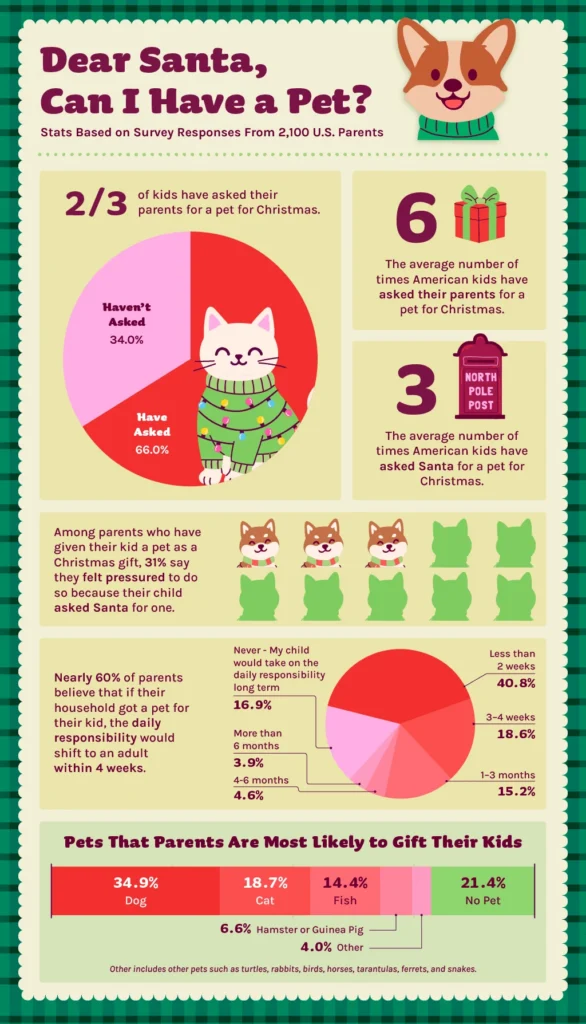
For plenty of kids, asking for a pet is not a one-time holiday wish. Sixty-six percent of kids have asked for a pet for Christmas, and, on average, parents say those requests come up nearly six times. In Texas and Ohio, parents report hearing the question more than 13 times, on average.
Santa gets pulled in, too. Among families who celebrate Christmas, parents say their children have asked Santa for a pet nearly three times, on average. It’s a charming wish and one that can be difficult for parents to ignore once it has been repeated all season.
Still, parents may be thinking beyond the excitement of Christmas morning. Nearly 60% believe that if their household got a pet primarily for their child, most of the daily responsibility would shift to an adult within four weeks. One in five parents say that would happen in less than a week.
When it comes to the pets parents would be most likely to choose as a Christmas or winter-holiday gift, dogs lead by a wide margin. More than one-third of parents (35%) say a dog would be their top choice, nearly twice the share who would choose a cat (19%). Meanwhile, 21% say they would not choose any of the listed pets in the survey as a holiday gift.
Holiday Fun for Future Pet Parents
A puppy might be the most exciting thing a child could find under the Christmas tree, but it is also a long-term family commitment. For families who aren’t quite ready to bring home a dog just yet, there are still plenty of ways for kids to celebrate their love of animals. Explore Yay! Coloring Pages’ dog coloring pages for a screen-free pet-themed activity, or pair them with Santa coloring pages to keep the Christmas magic going — all the joy of a holiday pet wish, minus the muddy paw prints.
Methodology
We surveyed 2,100 U.S. parents from September 23 to October 12, 2026, to explore when children are ready to help care for a dog, what families consider before getting a pet, and how pets factor into Christmas and other winter-holiday gift-giving. Respondents represented 42 states. Alaska, Hawaii, Montana, North Dakota, Rhode Island, South Dakota, Vermont, and Wyoming were excluded from state-level findings due to a limited number of survey respondents in those states.
The survey was open to parents who celebrate Christmas as well as other winter holidays. While some findings reference Santa, those results, including how often children ask Santa for a pet, are based only on respondents who said they celebrate Christmas.
Fair Use
You are welcome to use, reference, and share non-commercial excerpts of this study with proper attribution. If you cite or cover our findings, please link back to this page so readers can view the full methodology, charts, and context.